
Categories
Buying a homePublished March 11, 2026
Building Your Island Dream: The Reality of Custom Homes in Galveston

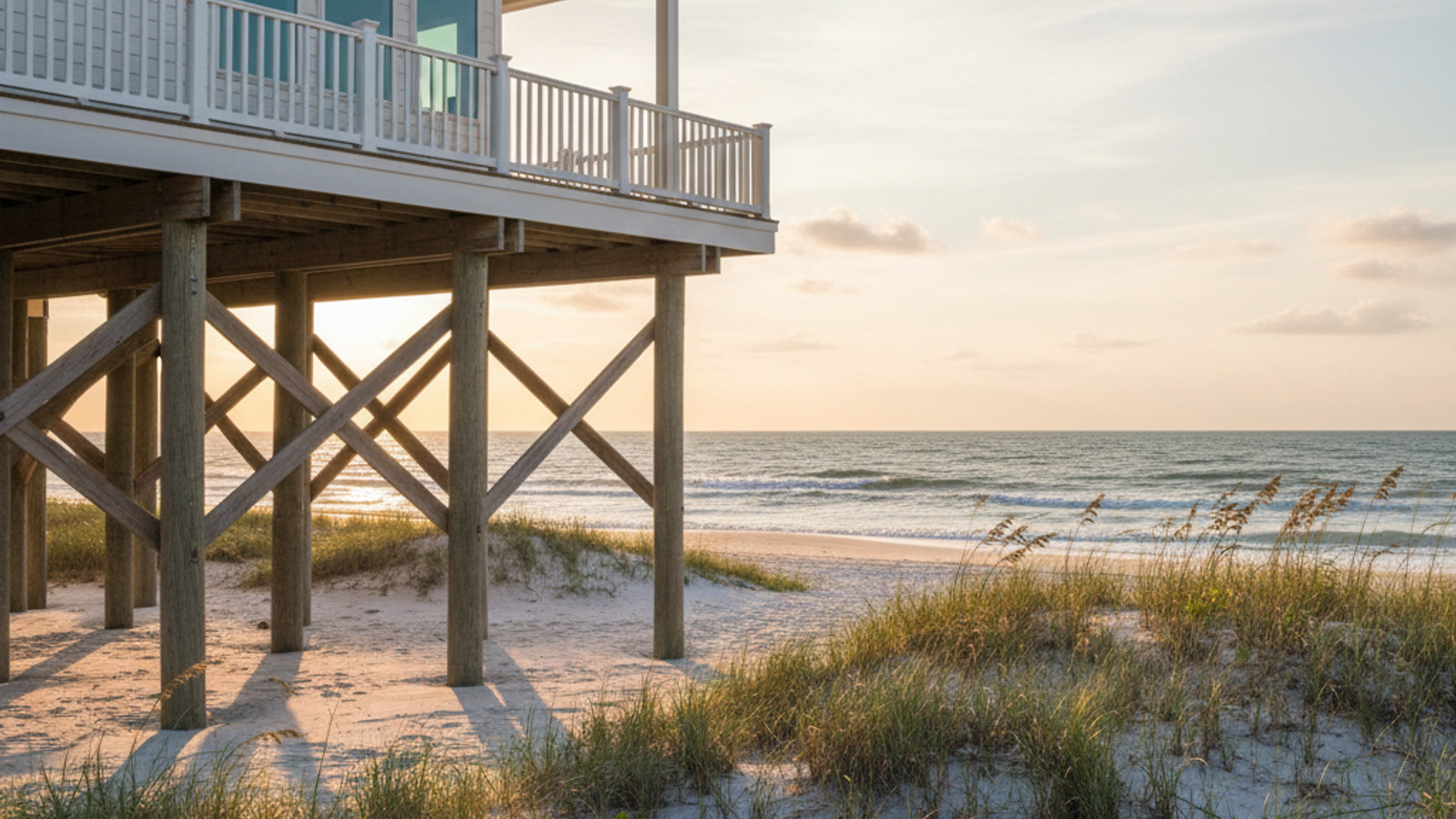
There is something undeniably magnetic about Galveston. Maybe it’s the history, the sound of the waves, or just the laid-back pace of life on the island. But if you are thinking about turning that daydream into a permanent address by building a custom home here, we need to have a serious chat.
Building on the coast is not like building in a subdivision in Houston or Dallas. It is a completely different animal. While the end result—coffee on your deck watching the sunrise over the Gulf—is absolutely worth it, the road to get there is paved with strict regulations and unique challenges.
We call this the "Coastal Premium." It’s the reality that everything here takes a little longer, costs a little more, and requires a lot more paperwork than you might expect. To successfully build here, you aren't just hiring a builder; you are navigating a complex web of FEMA flood zones, Texas Windstorm Insurance Association (TWIA) rules, and potentially historic preservation standards. Let’s break down exactly what that looks like so you can move forward with your eyes wide open.
Step 1: Choosing Your Lot – West End vs. In-Town
Before you even look at floor plans, you have to understand that Galveston is essentially two different worlds when it comes to construction. Your experience will depend entirely on where your lot is located.
The West End (Beach & Bay) When most people imagine a "Galveston beach house," this is what they are picturing. The West End is dominated by vacation rentals and second homes. Here, you are almost exclusively looking at homes built on stilts (pilings). The regulatory environment here is intense because you are dealing with the open elements. You are likely in a FEMA V-Zone or high-risk A-Zone, meaning the structure has to be elevated significantly to let water pass underneath.
In-Town (East End & Historic Districts) If you are looking closer to the Strand or the Seawall, you are dealing with urban infill. The lots are often narrow, and the vibe is much more traditional neighborhood than beach resort. If you buy in one of the historic districts, you aren't just answering to the city and FEMA; you also have to satisfy the Galveston Landmark Commission. They care deeply about aesthetics—window styles, porch railings, and roof pitches.
Due Diligence is Key Regardless of which side of the island you choose, never close on a lot without doing your homework. You need to verify soil conditions (sandy soil behaves differently than clay) and get an elevation certificate. If you are browsing our Galveston neighborhoods guide, pay close attention to which flood zone a specific street falls into, as it can change from one block to the next.
Critical Context: Understanding Flood Zones and Windstorm Certification
If you take nothing else away from this article, let it be this section. In Galveston, safety and insurance drive every single construction decision. You cannot design a house and then think about wind and flood; they have to be baked into the design from day one.
FEMA Flood Zones You will hear builders throw around terms like "V-Zone" and "A-Zone." Here is the plain English translation. A V-Zone (Velocity Zone) is an area where, during a storm, you can expect powerful crashing waves. If you build here, your foundation usually needs to be open (pilings) so waves don't knock the house down. An A-Zone expects rising water (flooding) but not necessarily crashing waves. This might allow for a different type of foundation, like a stem wall with flood vents, but you are still elevating the living space.
Elevation Requirements Every property has a Base Flood Elevation (BFE). If the BFE is 13 feet, your lowest living floor must be at least that high. However, smart locals build to "Freeboard" standards—meaning you build 1, 2, or even 3 feet higher than the minimum requirement. Why? Because every foot of extra height can drastically lower your flood insurance premiums.
TWIA & The WPI-8 Certificate This is the big one. In most of Texas, you just need a building permit. On the coast, you need a WPI-8 Certificate to get windstorm insurance through the Texas Windstorm Insurance Association (TWIA). Without a WPI-8, your home is essentially uninsurable for wind damage.
Here is the catch: You cannot get a WPI-8 after the house is finished. The inspections must happen during construction—specifically before the walls are closed up. A certified engineer or a Texas Department of Insurance (TDI) inspector has to verify the framing, the strapping, and the window installations. If you miss this window, there is no going back.
Step 2: Budgeting for a Coastal Build in 2026
Let’s talk money. I often talk to folks who look at national or even Texas average building costs and assume they can build here for $150 a square foot. I hate to be the bearer of bad news, but that math does not work on the island.
Cost Per Square Foot For a custom coastal home in 2026, you need to adjust your expectations. While a very basic build might start around $250 per square foot, a true custom home with decent finishes is likely landing in the $300 to $400+ range. Luxury builds go higher. This isn't just builder markup; it’s the cost of durability.
The "Invisible" Costs Where does that money go? A huge chunk goes into things you will never see once the house is painted.
- Foundations: Driving timber or concrete pilings 15 to 20 feet into the ground requires heavy machinery and expensive materials.
- Windows: You need high-impact, hurricane-rated windows. These can easily cost three times as much as standard residential windows.
- Connectors: We use specialized stainless steel or galvanized strapping to tie the roof to the walls and the walls to the floor. It’s like wrapping your house in a steel cage.
Insurance Implications Think of your construction budget as a down payment on your future monthly bills. If you cut corners on materials or elevation now, you will pay for it every single month in higher TWIA and NFIP (National Flood Insurance Program) premiums. Spending an extra $10,000 on a metal roof or extra elevation could save you that much in insurance over just a few years.
Step 3: Building Your Team & Vetting Contractors
Because the stakes are so high regarding regulations, your choice of builder is the most critical decision you will make. You cannot just hire a buddy who builds great ranch houses in Austin. You need someone who speaks the language of salt and sand.
Builder Vetting When you are interviewing top custom home builders in Galveston, ask specific questions. Don't just ask "Have you built here before?" Ask:
- "How many WPI-8 certified homes have you completed in the last two years?"
- "Who is your preferred structural engineer?"
- "How do you handle the inspection schedule for windstorm certification?"
Architects & Engineers You will also need a structural engineer who is intimately familiar with coastal wind loads. The wind pressure on a house right on the beach is massive compared to a house five miles inland. Your architect needs to design not just for beauty, but for aerodynamics and water intrusion.
Fraud Prevention After every major storm, we see "storm chasers"—contractors who roll into town looking for quick cash. Always verify licenses, check local court records for liens, and ask for references from past clients who have lived in their homes for at least a few years. You want to know if the roof leaked during the last tropical storm, not just if the kitchen looked pretty on day one.
Can I Build My Own House in Galveston? (DIY vs. Pro)
I get asked this a lot: "Can I just be my own General Contractor and save the management fee?"
Legality: Yes, Texas allows you to act as your own General Contractor. There is no law stopping you.
The Risk: However, I strongly advise against it unless you have professional construction management experience. Remember the WPI-8 we talked about? If you, as the owner-builder, forget to call the windstorm engineer before the drywall goes up, you have just built an uninsurable house. The resale value will plummet, and you will be stuck with it.
Recommendation: The savings you get from DIY-ing are often eaten up by mistakes and delays. A local GC knows exactly which inspector to call and when. For a coastal build, that expertise is worth the premium.
Step 4: The Construction Process & Timeline
Building on an island takes time. Between the bridge traffic, the humidity affecting cure times, and the permit process, patience is a requirement.
Phase 1: Pre-Construction (3-6 Months) This is the paperwork phase. You’ll be ordering a site survey, getting soil testing, and finalizing architectural designs. Your builder will submit everything to the City of Galveston and potentially the Landmark Commission. This is also when the structural engineer does their heavy lifting.
Phase 2: Foundation (1-2 Months) This is the loud part. If you are on the West End, a pile driver will be hammering massive poles into the earth. It shakes the ground and makes a racket, but it’s the sound of stability. If you are in-town, you might be pouring an elevated slab with extensive rebar work.
Phase 3: Framing & Dry-In Once the skeleton is up, the clock stops for inspections. This is the "do or die" moment for your windstorm certification. The engineer checks every strap, clip, and nail pattern. You cannot insulate or drywall until this gets the green light.
Phase 4: Finishes & Final Once the walls are closed, it starts to look like a home. This phase includes interior trim, flooring, and utility connections.
Total Timeline Realistically, if you are building a custom home today, plan for a 12 to 16-month timeline from contract to keys. If you decide to manage it yourself, you can likely add another 3 to 6 months to that schedule.
Step 5: Final Inspections and Move-In
You are almost there. The final stretch involves a flurry of paperwork that is just as important as the foundation.
First, the City of Galveston will do their final walkthrough to issue the Certificate of Occupancy (CO). You cannot legally live in the home without this. Simultaneously, your windstorm engineer will submit the final paperwork to TWIA to generate that golden WPI-8 Certificate.
Pro Tip: When you get the physical WPI-8 document, make digital copies and put the original in a fireproof safe. If you ever decide to sell, that piece of paper is the first thing a buyer's agent will ask to see.
Once the utilities are on and you’ve transitioned from a Builder’s Risk policy to a standard Homeowner’s (and Flood/Wind) policy, you are ready to move in.
Frequently Asked Questions
How much does it cost to build a house in Galveston, TX?
It varies wildly by finish level and location, but for a custom build in 2026, you should budget between $300 and $400+ per square foot. This is higher than inland Texas due to the cost of pilings, impact-rated materials, and specialized labor required for coastal codes.
What is a WPI-8 certificate and why do I need it?
A WPI-8 is a certificate of compliance issued by the Texas Department of Insurance. It proves your home was built to withstand high winds. Without it, you generally cannot purchase windstorm insurance through TWIA, which is often the only option for coastal properties.
Can I build a house on the ground in Galveston?
It depends entirely on your Flood Zone. In V-Zones (beachfront), absolutely not—you must build on open pilings. In some A-Zones or protected areas behind the Seawall, you may be able to build on a slab, but it usually still needs to be elevated above the Base Flood Elevation (BFE) to get affordable insurance.
How long does it take to build a custom home in Galveston?
You should plan for 12 to 16 months for a professionally managed custom build. This accounts for the slower permitting process, potential weather delays (hurricane season can pause work), and the complexity of scheduling specialized inspections.
Is it cheaper to buy or build in Galveston?
Generally, it is cheaper and faster to buy an existing resale home. Building a custom home is a premium choice that allows you to get exactly what you want, but you will pay current market rates for labor and materials, which have risen significantly since 2020.
April Aberle
REALTOR ® | Mortgage Originator | Homes for Heroes Affiliate | April Aberle | REMAX Crossroads Realty
or another way